
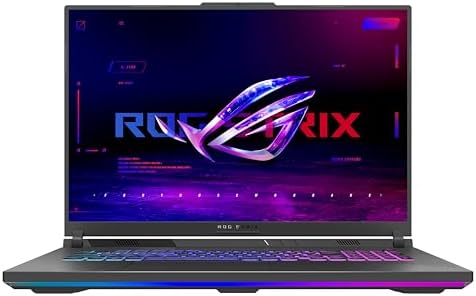
The era of the “thin-and-light” gaming laptop, a dominant design philosophy for nearly a decade, is ceding ground to a new industrial reality in 2025: thermal mass dictates performance. As silicon manufacturers push voltage limits to achieve generational gains, the chassis has had to grow to accommodate the heat. Leading this resurgence of the 18-inch “desktop replacement” form factor is the ASUS ROG Strix G18 (Model G815), a device that serves as a case study in modern thermal engineering and architectural specialization. This machine represents a pivot away from general-purpose computing toward a landscape defined by localized artificial intelligence and disaggregated processor architectures.
The 2025 Strix G18 presents a fascinating, somewhat paradoxical configuration. By pairing a flagship-tier Intel Core Ultra 9 275HX processor with a mid-range NVIDIA GeForce RTX 5060 Laptop GPU, ASUS has created a specialized tool targeting a high-growth market segment: users who require workstation-grade processing power for simulation and compilation, but for whom 4K graphical rasterization is a secondary concern.
The Renaissance of the 18-Inch Form Factor
For years, the industry chased the “Max-Q” ethos, attempting to shrink high-performance hardware into sub-20mm frames. The return to the 18-inch chassis is not merely an aesthetic nostalgia trip to the days of the Alienware 18; it is an engineering necessity. Modern flagship mobile CPUs and GPUs operate within high-wattage envelopes that physically overwhelm smaller heat sinks.
The G815 utilizes its expansive footprint to house an “End-to-End” heatsink and a Tri-Fan cooling array. Unlike standard dual-fan systems, this configuration introduces a third auxiliary fan dedicated to airflow over the GPU Video Memory (VRAM) and voltage regulators. This crucial addition prevents “silent” throttling—a scenario where a system downclocks not because the core chip is hot, but because the power delivery components around it are overheating. This thermal headroom allows the components to run closer to their desktop counterparts, sustaining a combined system load between 190W and 230W.
Silicon Shift: Efficiency Over Thread Count
The computational heart of the G18 is the Intel Core Ultra 9 275HX, part of the “Arrow Lake-HX” generation. This chip marks a definitive departure from Intel’s legacy monolithic manufacturing. Instead, it uses a disaggregated “tile” architecture, placing the compute tile on a cutting-edge 3nm process node.
The most controversial architectural change is the complete removal of Hyper-Threading Technology. For years, Hyper-Threading allowed one physical core to handle two logical threads. However, logic threads consume power and generate heat while offering diminishing returns. By removing them, Intel has optimized the 24 physical cores (8 Performance and 16 Efficiency) to run at higher sustained frequencies.
Benchmarks validate this bold engineering choice. The 275HX outperforms its predecessor, the i9-14900HX, by approximately 11% in multi-core tests, scoring in the 39,000-point range on Cinebench R23. This confirms that for 2025, physical core throughput trumps logical thread count, particularly when managing heavy workloads like code compilation or 3D rendering.
Graphics: The Bandwidth Breakthrough
On the graphical front, the G18 integrates the NVIDIA GeForce RTX 5060, built on the Blackwell architecture. While considered a mid-range card, it introduces a transformative technology to the mass market: GDDR7 memory.
Previous “60-class” GPUs were frequently bottlenecked by slow memory speeds, which starved the processor of data at resolutions above 1080p. The move to GDDR7 nearly doubles the memory bandwidth to approximately 448 GB/s. This allows the RTX 5060 to effectively drive the laptop’s native 2.5K (2560 x 1600) display without the stuttering issues that plagued previous generations.
However, the GPU is not without limitations. It retains an 8GB VRAM capacity. In modern titles utilizing Unreal Engine 5, high-resolution textures can easily fill this buffer. When VRAM is full, data spills into the slower system RAM, causing performance degradation. To mitigate this, the system relies heavily on DLSS 4, an AI-driven upscaling technology that generates intermediate frames to ensure smooth motion, bridging the gap between raw hardware power and the demands of the 240Hz screen.
The AI Paradigm and Future-Proofing
The “Gaming AI Laptop” branding reflects a tangible hardware requirement for the coming years: the move from cloud-based AI to edge-based inference. The G18 distributes AI workloads across three distinct processors:
- The GPU (RTX 5060): Handles heavy, burst-load AI tasks like image generation and DLSS upscaling.
- The CPU (Core Ultra 9): Manages complex logic and game AI.
- The NPU (Neural Processing Unit): A dedicated low-power engine integrated into the Intel silicon.
The NPU, capable of 13 TOPS (Trillions of Operations Per Second), handles sustained background tasks such as noise suppression and video background blur. By offloading these constant drains from the hungry GPU, the NPU significantly improves energy efficiency during daily tasks.
Navigating the Retail Landscape: The “DLCA” Bundle
Potential buyers researching the G18 will likely encounter listings referencing a “DLCA Accessory” bundle. Investigative analysis confirms that this is not a proprietary hardware technology or a special port. Rather, it is a logistical strategy used by third-party retailers.
By bundling generic items—often a basic HDMI cable, USB hub, or mouse pad—retailers create a unique Stock Keeping Unit (SKU). This technique prevents their listings from being automatically price-matched against bare-bones listings from major competitors. Consumers should evaluate the ASUS ROG Strix G18 based strictly on its core specifications and price point, viewing the “DLCA” tag as transactional noise rather than a value-add feature.
Verdict: A Specialized Tool for the Hybrid User
The ASUS ROG Strix G18 (2025) rejects the “balanced” approach of traditional laptops in favor of specialized throughput. It creates a clear divide in the market. For the pure gamer seeking maximum graphical fidelity per dollar, a machine with a higher-tier GPU and a lesser CPU may offer better value. However, the G815 targets a specific, sophisticated demographic.
For the engineering student, the game developer, or the competitive gamer who demands uncompromised CPU compute for simulation and a massive, color-accurate workspace, the G18 is a market-leading solution. It successfully leverages the physics of its 18-inch chassis to tame the heat of next-generation silicon, proving that in 2025, size is once again a virtue.

- ASUS ROG STRIX G18 (G815LP-XS97), Intel Core Ultra 9 275HX (2.1GHz – 5.4GHz) Processor
- 18″ 2.5K 240Hz (3ms) QHD+ IPS-Level Anti-Glare (2560 x 1600) 100% DCI-P3 Display w/ 500nits Brightness
- 32GB (2x 16GB) DDR5 5600MHz Memory
- PERFORMANCE REDEFINED – Experience next-level performance with Windows 11, an AMD Ryzen 9 8940HX Mobile Processor, and a…
- HIGH-PERFORMANCE MEMORY AND STORAGE – Multitask seamlessly with 16GB of DDR5-5200MHz memory and store all your game libr…
- DYNAMIC DISPLAY – Immerse yourself in stunning visuals with the smooth 144Hz/3ms FHD+ display for gaming and entertainme…
- PERFORMANCE REDEFINED – Experience next-level performance with Windows 11, an AMD Ryzen 9 7940HX Mobile Processor, and a…
- HIGH-PERFORMANCE MEMORY AND STORAGE – Multitask seamlessly with 32GB of DDR5-5200MHz memory and store all your game libr…
- PREMIUM ROG NEBULA DISPLAY – Immerse yourself in stunning 500nit visuals with the ultra-fast ROG Nebula Display at 240Hz…